








If Fabric Unifies Where Your Data Lives, Fabric IQ Unifies What It Means

Contents
Introduction
A beginner’s guide to Microsoft Fabric IQ, ontologies, and the quiet shift from a unified data platform to a unified intelligence platform
For the last few years, the data world has been obsessed with one question: where does our data live?
We mirrored. We shortcutted. We poured lakehouses, warehouses, and eventhouses into OneLake until, finally, everything had one home. And it worked Microsoft Fabric genuinely delivered on the promise of “one copy, one place, every workload.”
If you are not a member, you can still read this article for free here
But somewhere along the way, a lot of us hit an uncomfortable truth: putting every table in one lake doesn’t mean anyone actually understands it.
A table called dim_cust with a column named arr_v2 means almost nothing to an AI agent. It means almost nothing to the analyst who joined your team last week, either. The data is there unified, governed, beautifully consolidated but the meaning is still scattered across reports, tribal knowledge, and three slightly different definitions of “active customer” that nobody can reconcile.
That gap between unified data and fragmented meaning is exactly what Fabric IQ was built to close.
If Fabric unified where your data lives, Fabric IQ unifies what it means.
So what actually is Fabric IQ?
Fabric IQ is the semantic intelligence layer of Microsoft Fabric. Its job is to take all that analytical, real-time, and operational data you’ve already unified and elevate it into the language of your business, so that both people and AI agents can reason over it correctly.
It’s also part of a bigger family. Microsoft IQ is the enterprise intelligence layer across the stack, and Fabric IQ sits alongside three siblings:
- Work IQ : context on how your people work
- Foundry IQ : context from your policies and authoritative documents
- Web IQ : context from the web
- Fabric IQ : context on your business entities and data the actual state of your business
A quick note on maturity, because it matters: Fabric IQ was first previewed at Ignite 2025 and reached general availability at Microsoft Build in June 2026. The core Ontology item is still in preview. There’s no separate SKU it runs on your existing Fabric capacity so trying it out is mostly a question of time, not procurement.
The three layers (this is the mental model to keep)
Fabric IQ brings three layers of business context to the platform. If you remember nothing else, remember these:
- Unified data : OneLake. The foundation. Your lakehouses, eventhouses, and semantic models, unified into a single governed source of truth across clouds and on-prem, thanks to shortcuts and mirroring.
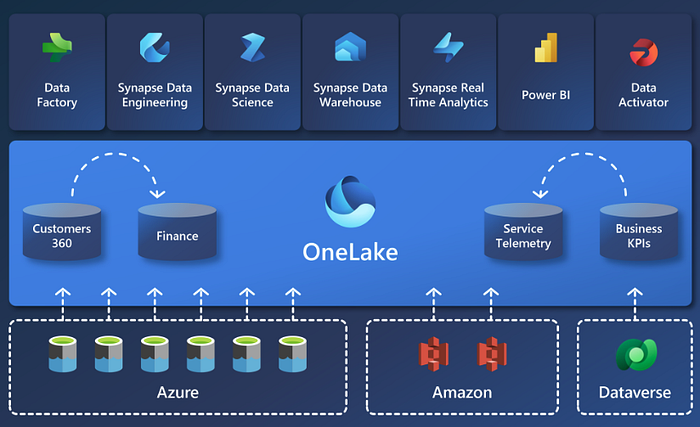
2. Business intelligence : Power BI semantic models. The curated analytics layer you already know and trust: measures, hierarchies, dimensions. The KPIs your business already runs on.
3. Operational intelligence : the Ontology. The new piece. This is where raw data finally gets a vocabulary.
The magic is that these layers aren’t separate products you bolt together they’re delivered through two core items (the semantic model and the ontology) that share the same context over your OneLake data.
Meet the ontology
If “ontology” sounds like a word from a philosophy seminar, relax in Fabric it’s refreshingly practical.
An ontology is a shared, machine-understandable vocabulary of your business. It captures:
- Entities : the things that matter: Customer, Shipment, Asset, Runway, Breach
- Properties : the facts about those things
- Relationships : how they connect: a Customer places an Order; a Weather Event impacts a Runway
- Rules and actions : the logic that governs them, and what can actually be done
And here’s the part that makes it adoptable instead of intimidating: it’s no-code and visual, so business experts can shape and evolve it without a heavy engineering lift. Even better , if your data is already in a Power BI semantic model, you can generate an ontology directly from it. You bootstrap from logic and definitions you’ve already battle-tested in production, instead of starting from a blank canvas.
Define “Customer,” “Shipment,” or “Breach” once and reuse that meaning everywhere.
Why a graph beats a pile of joins
Under the ontology sits a native graph engine, and this is where it stops being “just metadata.”
Traditional relational joins are great at answering “how many?” They’re miserable at answering “why?” the kind of question that requires hopping across five connected things to explain an outcome.
With Fabric IQ’s graph (queryable with GQL, Graph Query Language), you can traverse a chain like:
Order → Shipment → Temperature Sensor → Cold Chain Breach
…and actually explain why a delivery spoiled, not just count that it did. That’s multi-hop reasoning, and it surfaces dependencies that flat tables hide. There’s also a natural-language layer (NL2Ontology) that turns plain business questions into structured queries , so you don’t have to hand-write GQL to get value.
Where the AI agents come in
This is the payoff, and it ties straight back to something I wrote about earlier , Fabric Data Agents.
Once your business has a shared, governed vocabulary, two kinds of agents can stand on top of it:
- Data agents : conversational “virtual analysts.” Ask a question in plain language, get an answer that spans multiple sources without hand-written SQL, with explainable, traceable citations back to the data.
- Operations agents : the autonomous end of the spectrum. They monitor live data, detect anomalies, reason over your business semantics, and take governed action : escalating, rerouting, flagging all grounded in the same shared context.
The unlock isn’t “AI that reads your data.” We’ve had that. It’s AI that understands your business well enough to reason about cascading effects and act responsibly.
Let’s make it concrete
Picture a cold-chain logistics company. Historically, “a shipment spoiled” is a fire drill: someone notices late, then pings three siloed systems to reconstruct what happened.
With Fabric IQ:
- Model it once. Define entities : Order, Shipment, Truck, Temperature Sensor, Cold Chain Breach and the relationships between them in the ontology.
- Bind it to live data. Map those entities to OneLake warehouses for history and an eventhouse for live sensor telemetry.
- Let the graph reason. When a sensor reading crosses a threshold, an operations agent traverses
Sensor → Shipment → Order → Customer, understands which customer’s which order is now at risk, and takes a governed action notify, reroute, or open a case.
No analyst manually stitching systems together at 2 a.m. The meaning was already there.
The honest “early days” caveat
I’d be doing you a disservice if I made this sound finished. Fabric IQ is GA, but the Ontology item is still in preview, and capacity meters for it are expected in the coming months. Treat this as the right time to learn and prototype, not necessarily the moment to bet your production SLAs on it. Build a small ontology, generate one from a semantic model you already trust, and get a feel for the graph. That’s where the learning compounds.
The shift underneath all of this
Step back and the bigger story is simple: we’re moving from a unified data platform to a unified intelligence platform. For years our job was getting the data into one place. The next chapter is giving that data meaning so both humans and agents start every question with the same understanding of the business.
If you’ve spent your career wrangling tables, this is the most exciting plot twist in a while. Your data is finally learning to speak your language.
Views are my own and not those of my employer.
About the author
Navyasree Potluri
N, Potluri (09/07/2026) If Fabric Unifies Where Your Data Lives, Fabric IQ Unifies What It Means. If Fabric Unifies Where Your Data Lives, Fabric IQ Unifies What It Means | by Navyasree Potluri | CodeToDeploy | Jun, 2026 | Medium