








Copilot Agent Test Automation: From Prompt to Production with Confidence
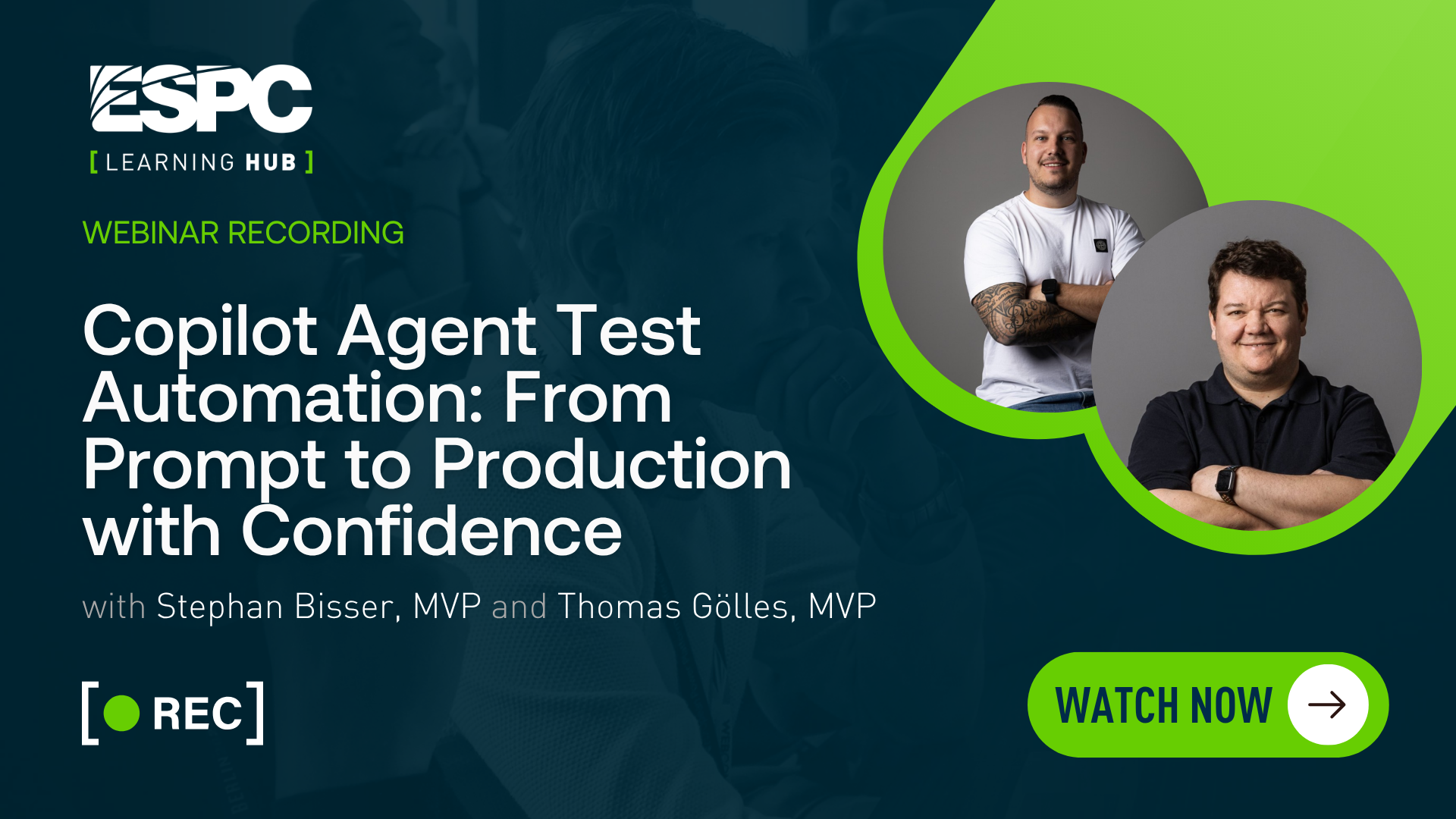
Copilot Agent Test Automation: From Prompt to Production with Confidence
The webinar, presented by MVP Stephan Bisser, explores the shift from traditional software testing to the specific challenges of Large Language Model (LLM) agent automation within Microsoft Copilot Studio.
The core premise is that while classical software behaves like “math” (deterministic), AI agents behave more like “the weather” (probabilistic), where the same input does not always guarantee the same output.
The following key themes provide an overview of the presentation’s technical and philosophical approach:
1. Agents as Hybrid Systems
Bisser argues that agentic systems are hybrid systems combining two distinct types of components:
- Deterministic components: These include APIs, authentication, database operations, and hard-coded business rules. They still benefit from traditional unit and integration testing.
- Probabilistic components: These involve reasoning, summarisation, tool selection, and natural language generation. These require behavioural evaluation rather than exact string matching, as multiple outputs may be equally acceptable.
2. Context Engineering and Evaluation
In agentic systems, “context is king.” Context includes system prompts, conversation history, and available tools. Because agents are probabilistic, debugging is about managing “responsible uncertainty” rather than seeking impossible perfection.
Bisser likens evaluating an agent to onboarding a new employee—it requires providing context, examples, and feedback over time rather than relying on a static specification.
3. Copilot Studio Capabilities and Gaps
Copilot Studio offers built-in evaluation features, such as the ability to generate test sets and measure metrics like groundedness and similarity. However, Bisser highlights several limitations:
- Context sensitivity: Automated test questions often fail if they lack specific user context.
- ALM integration: Built-in evaluations live in the cloud, not in source control, making it difficult to implement automated “gates” in a CI/CD pipeline.
4. The CULT Tool and Automation
To address these gaps, the presenter introduced CULT (Copilot Agent Linting Tool), a CLI tool designed to bring agents into a professional Application Lifecycle Management (ALM) workflow. Its features include:
- Instruction scanning: Linting instructions for quality (e.g., checking markdown structure, actionable verbs, and error handling).
- Security checks: Detecting guardrails for prompt injection and leakage based on OWASP Top 10 standards.
- Source control: Fetching instruction sets to be checked into version control systems like GitHub.
- Automated testing: Pushing local YAML-based test cases to Copilot Studio and running evaluations directly from the terminal or a deployment pipeline.
5. Architectural Best Practices
For improved testability, Bisser recommends splitting agents into small, single-purpose topics and keeping connectors behind abstractions so they can be mocked during testing. Success should be measured using varied metrics: intent matching, slot accuracy, action correctness, and response quality.
Live demos will showcase real-world automation techniques to validate Copilot agents end-to-end—giving you a clear, practical blueprint to confidently move from prototype to production.
you might also like